
添行与合成大矩阵。
构造矩阵联系起各种要素,从而进一步处理
例如,在行列式计算中,我们有所谓添行。
除了对角元以外都一样的行列式求解
$$ \begin{pmatrix} a & t & \cdots & t \\ t & a & \cdots & t \\ \vdots & \vdots & \ddots & \vdots \\ t & t & \cdots & a \end{pmatrix} $$
的行列式求解,一种是我们可以直接做行列变换,还有一种操作是构造一个更大的矩阵:
$$ \left( \begin{array}{c|cccc} 1 & t & t & \cdots & t\\ \hline 0 & a & t & \cdots & t \\ 0 & t & a & \cdots & t \\ \vdots & \vdots & \vdots & \ddots & \vdots \\ 0 & t & t & \cdots & a \end{array} \right) $$
此时行列式可以看做对第一列展开,仍然不变,这时执行消元,看起来简单的多。
$$ \begin{pmatrix} 1 & t & t & \cdots & t \\ -1 & a-t & 0 & \cdots & 0 \\ -1 & 0 & a-t & \cdots & 0 \\ \vdots & \vdots & \vdots & \ddots & \vdots \\ -1 & 0 & 0 & \cdots & a-t \end{pmatrix} $$
随后消去第一行或第一列即可
添行列+代数余子式
(pku25秋线代期中)已知 $|A| = 5, a_{11} = 2$,$A_{ij}$为元素$a_{ij}$ 的代数余子式。
$$ \text{求:} \begin{vmatrix} A_{22} & A_{23} & \cdots & A_{2n} \\ A_{32} & A_{33} & \cdots & A_{3n} \\ \vdots & \vdots & \ddots & \vdots \\ A_{n2} & A_{n3} & \cdots & A_{nn} \end{vmatrix} $$
我们容易想到余子式的正交性,添行:
$$ \begin{vmatrix} A_{11} & A_{12} & A_{13} & \cdots & A_{1n} \\ 0 & A_{22} & A_{23} & \cdots & A_{2n} \\ 0 & A_{32} & A_{33} & \cdots & A_{3n} \\ \vdots & \vdots & \vdots & \ddots & \vdots \\ 0 & A_{n2} & A_{n3} & \cdots & A_{nn} \end{vmatrix} $$
这时利用经典的 $det(AB) = det(A) \cdot det(B)$,我们左乘原来的矩阵的转置:
$$ \begin{pmatrix} a_{11} & a_{21} & a_{31} & \cdots & a_{n1} \\ a_{12} & a_{22} & a_{32} & \cdots & a_{n2} \\ a_{13} & a_{23} & a_{33} & \cdots & a_{n3} \\ \vdots & \vdots & \vdots & \ddots & \vdots \\ a_{1n} & a_{2n} & a_{3n} & \cdots & a_{nn} \end{pmatrix} \begin{pmatrix} A_{11} & A_{12} & \cdots & A_{1n} \\ 0 & A_{22} & \cdots & A_{2n} \\ \vdots & \vdots & \ddots & \vdots \\ 0 & A_{n2} & \cdots & A_{nn} \end{pmatrix} $$
利用正交性也就有:
$$ \begin{pmatrix} a_{11}A_{11} & a_{11}A_{12} + \dots & \cdots & a_{11}A_{1n} + \dots \\ 0 & |A| & \cdots & 0 \\ \vdots & \vdots & \ddots & \vdots \\ 0 & 0 & \cdots & |A| \end{pmatrix} $$
从而
$$ a_{11}A_{11}|A|^{n-1} = |A| \cdot A_{11} \cdot \det(\text{子矩阵}) \implies \text{子式} = |A|^{n-2} \cdot a_{11} $$
在矩阵操作中,也常有合成大矩阵
基础准备:分块矩阵的秩与行列式
根据Laplace展开,我们知道:
$$ \det \begin{pmatrix} A & O \\ C & B \end{pmatrix} = \det(A) \det(B) $$
同时,我们还有:
$$ rank \begin{pmatrix} A & O \\ O & B \end{pmatrix} = rank(A)+rank(B) $$
可以通过做行列变化得到,以及:
$$ rank \begin{pmatrix} A & O \\ C & B \end{pmatrix} \ge rank(A)+rank(B) $$
Frobenius不等式的证明
$$ \text{rank}(ABC) + \text{rank}(B) \ge \text{rank}(AB) + \text{rank}(BC) $$
我们构造如下的 $2 \times 2$分块矩阵$M$:
$$ M = \begin{pmatrix} AB & O \\ B & BC \end{pmatrix} $$
这里不难看出,$rank(M)>=rank(AB)+rank(BC)$,如果构造左下角是$O$,虽然直接等于了,但我们没什么操作空间。这时我们行列变换消去左上角和右下角:
$$ \begin{pmatrix} AB & O \\ B & BC \end{pmatrix} \xrightarrow{R_1 - AR_2} \begin{pmatrix} O & -ABC \\ B & BC \end{pmatrix} \xrightarrow{C_2 - C_1C} \begin{pmatrix} O & -ABC \\ B & O \end{pmatrix} $$
那么也就得到了想要的结论
Sylvester不等式
虽然和主题无关,但只要将$B$取为$I$,我们也就得到了Sylvester不等式:
$$ \text{rank}(AC) + \text{rank}(I) \ge \text{rank}(A) + \text{rank}(C) $$
即:
$$ \text{rank}(AC) \ge \text{rank}(A) + \text{rank}(C) - n $$
这个不等式在秩相关问题可以大展身手。例如证明$\text{rank}(A) = n-1$时伴随矩阵秩1:
因为 $\text{rank}(A) = n-1$,所以存在一个 $n-1$阶子式不为$0$,故 $A^* \neq O$,得 $\text{rank}(A^*) \ge 1$。
此时 $\det(A) = 0$,代入定义式得 $A \cdot A^* = O$。
构造秩的不等式:
根据 $\text{rank}(AB) = 0 \implies \text{rank}(A) + \text{rank}(B) \le n$:
$$ \text{rank}(A) + \text{rank}(A^*) \le n $$
$$ (n-1) + \text{rank}(A^*) \le n \implies \text{rank}(A^*) \le 1 $$
证明$\det(I+AB) = \det(I+BA)$
类似地我们构造:
$$ \begin{pmatrix} I & A \\ O & I+BA \end{pmatrix} $$
然后进行消元操作:
$$ \begin{pmatrix} I & A \\ O & I+BA \end{pmatrix} \xrightarrow{R_2 - BR_1} \begin{pmatrix} I & A \\ -B & I \end{pmatrix} \xrightarrow{R_1 + AR_2} \begin{pmatrix} I-AB & O \\ B & I \end{pmatrix} $$
也就证明了结论
$AB$与$BA$ 特征多项式的关系
设 $A \in \mathbb{F}^{m \times n}, B \in \mathbb{F}^{n \times m}$,则:
$$ \lambda^n \det(\lambda I_m - AB) = \lambda^m \det(\lambda I_n - BA) $$
如法炮制,构造矩阵:
$$ \begin{pmatrix} \lambda I_m - AB & O \\ B & I_n \end{pmatrix} $$
消元:
$$ \begin{pmatrix} \lambda I_m - AB & O \\ B & I_n \end{pmatrix} \xrightarrow{R_1 + AR_2} \begin{pmatrix} \lambda I_m & A \\ B & I_n \end{pmatrix} \xrightarrow{R_2 - \frac{1}{\lambda}BR_2} \begin{pmatrix} \lambda I_m & A \\ O & I_n - \frac{1}{\lambda}B A \end{pmatrix} $$
从而
$$ \det(\lambda I_m - AB) = \lambda^{m-n} \det(\lambda I_n - BA) $$
这显然与结论等价。
Binet-Cauchy公式的证明
具体公式为:若 $A$是$n \times m$ 矩阵,$B$是$m \times n$ 矩阵($n \le m$),则:
$$ \det(AB) = \sum_{1 \le j_1 < j_2 < \dots < j_n \le m} \det(A_{j_1, \dots, j_n}) \det(B^{j_1, \dots, j_n}) $$
其中 $A_{j_1, \dots, j_n}$是取$A$的第$j_1, \dots, j_n$ 列构成的方阵,$B^{j_1, \dots, j_n}$是取$B$的第$j_1, \dots, j_n$ 行构成的方阵。
证明:
构造一个 $(n+m) \times (n+m)$ 的分块矩阵:
$$ M = \begin{pmatrix} I_m & B \\ -A & 0 \end{pmatrix} $$
利用拉普拉斯展开直接对 $M$进行展开。在展开过程中,由于$I_m$是单位阵,只有选取的行和列匹配时才非零,最终会自然产生$\sum \det(A_J) \det(B^J)$ 的形式。
总结
大概如是,使用情景大概为:
乘积顺序交换: 涉及到 $AB$与$BA$ 的对称性。
秩的不等式: 出现三个或更多矩阵连乘(如 Frobenius)。
行列式中绝大多数元素有规律: 构造 $n+1$ 阶矩阵引入辅助变量。
Gemini给出了所谓的构造模版,可供一观: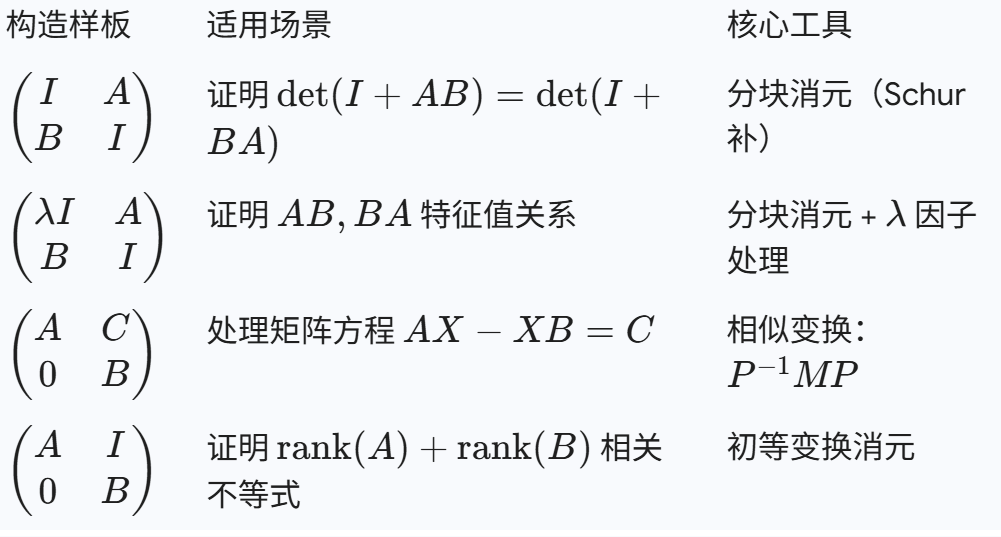
Vandermonde行列式
通过多项式因式分解确定行列式形式
Vandermonde行列式
设 $n$ 阶范德蒙德行列式为:
$$ V_n = \begin{vmatrix} 1 & 1 & \cdots & 1 \\ x_1 & x_2 & \cdots & x_n \\ x_1^2 & x_2^2 & \cdots & x_n^2 \\ \vdots & \vdots & \ddots & \vdots \\ x_1^{n-1} & x_2^{n-1} & \cdots & x_n^{n-1} \end{vmatrix} $$
我们要证明:$V_n = \prod_{1 \le i < j \le n} (x_j - x_i)$。
当 $n=2$ 时:
$$ V_2 = \begin{vmatrix} 1 & 1 \\ x_1 & x_2 \end{vmatrix} = x_2 - x_1 $$
公式成立。
假设公式对于 $n-1$ 阶范德蒙德行列式成立。
对最后一列展开,显然是最高次为$x_n^{n-1}$的多项式,最高次系数根据归纳假设为$V_n = \prod_{1 \le i < j \le n-1} (x_j - x_i)$,注意到$x_n$等于$\forall i < n, i \in \mathbb{N}^+$的时候多项式为$0$,也就是说可以因式分解为:
$$ \prod_{1 \le i \le n-1}(x_n - x_i)\prod_{1 \le i < j \le n-1} (x_j - x_i) $$
合并即可得到结论。
Cauchy行列式
证明 $n$ 阶 Cauchy 行列式:(由AI给出,懒得打了)
$$ C_n = \begin{vmatrix} \frac{1}{a_1+b_1} & \cdots & \frac{1}{a_1+b_n} \\ \vdots & \ddots & \vdots \\ \frac{1}{a_n+b_1} & \cdots & \frac{1}{a_n+b_n} \end{vmatrix} = \frac{\prod_{1 \le i < j \le n} (a_j - a_i)(b_j - b_i)}{\prod_{i=1}^n \prod_{j=1}^n (a_i + b_j)} $$
第一步:基础步骤
当 $n=1$ 时:
左边 $= \frac{1}{a_1+b_1}$- 右边:分子为空积(定义为$1$),分母为 $a_1+b_1$。
等式成立。
第二步:归纳假设与行列式变换
假设对于 $n-1$阶行列式公式成立。对于$n$ 阶行列式,我们要利用初等变换将其降阶。
- 消去第一行以外的元素:
对行列式进行列变换。用第 $j$列减去第$n$ 列 ($j=1, 2, \dots, n-1$):
$$ c_{ij}' = \frac{1}{a_i+b_j} - \frac{1}{a_i+b_n} = \frac{b_n - b_j}{(a_i+b_j)(a_i+b_n)} $$
2. 提取公因子:
从每一列 $j$ ($j < n$) 提取公因子 $(b_n - b_j)$。
从每一行 $i$提取公因子$\frac{1}{a_i+b_n}$。
从每一列 $j$ ($j < n$) 提取公因子 $\frac{1}{a_n+b_j}$(为了让最后一行变简单)。
经过一系列复杂的提取(或直接对每一项进行代数变形),行列式可以转化为:
$$ C_n = \frac{\prod_{j=1}^{n-1}(b_n-b_j) \cdot \prod_{i=1}^{n-1}(a_n-a_i)}{\prod_{i=1}^n(a_i+b_n) \cdot \prod_{j=1}^{n-1}(a_n+b_j)} \cdot C_{n-1} $$
第三步:递推求解
将归纳假设中的 $C_{n-1}$ 代入上述递推式:
分子部分:$C_{n-1}$贡献了$1 \le i < j \le n-1$的差积,递推项贡献了包含$n$的差积(如$a_n-a_i$和$b_n-b_j$)。合起来正好构成 $1 \le i < j \le n$ 的完整差积。
分母部分:$C_{n-1}$贡献了前$n-1$行列的所有组合,递推项正好补齐了第$n$行和第$n$列的所有组合$(a_i+b_n)$和$(a_n+b_j)$。
结论:等式对 $n$ 阶成立。